 How-to
How to Stop Repetitive Fighting: A Practical Guide for Couples
Last Updated: November 17, 2026
Quick Summary
Repetitive fighting usually persists because the surface topic is not the real issue, so the unmet underlying need never gets addressed. Stop the cycle by naming the trigger and the need, slowing down, listening to understand, and agreeing on a structured timeout when emotions rise.
- Name the trigger and the underlying need behind the recurring argument.
- Avoid blame and labels; speak about your own experience instead.
- Agree in advance on a timeout signal, a 20 to 30 minute duration, and a return time.
- Restart by paraphrasing your partner's position before adding anything new.
- Track progress over a month, noting trigger, intensity from 1 to 10, and whether agreed changes happen.
Table of Contents
- Why Couples Keep Having the Same Argument
- How to Communicate During Conflict With Your Partner
- How to Repair a Relationship After a Fight
- Couples Communication Exercises to Practice This Week
- Frequently Asked Questions
Why Couples Keep Having the Same Argument
Repetitive fighting usually means the surface topic is not the real issue. Dishes, money, or late replies are often just the trigger for a deeper need that never gets met. Repetitive fights often involve individuals who find themselves having the same argument again and again, and the pattern is rarely about the dishes.
When the same argument keeps returning, a few things are usually happening at once:
- The underlying need is unspoken. One partner may want reassurance, another may want space.
- Emotions escalate quickly. Feeling criticized triggers defense, and the conversation drifts from the original issue.
- Each partner has a different script. Both keep playing familiar roles.
Naming the trigger and the underlying need is the first step to breaking the cycle.
How to Communicate During Conflict With Your Partner
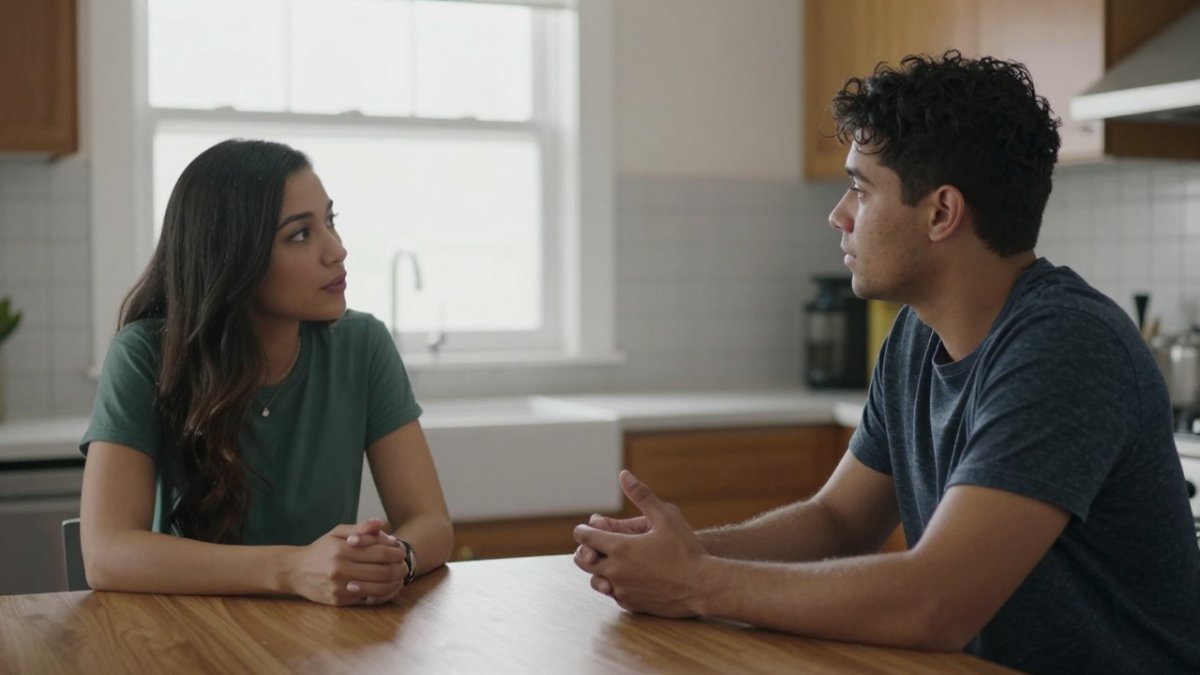
Good communication during conflict is less about winning and more about understanding. Learn how to communicate your needs to a partner in a practical walkthrough. Slowing the exchange down early helps before either person becomes defensive. Listen to understand before you respond, and reflect back what you heard in your own words, such as "It sounds like you felt dismissed when I changed plans."
Keep these habits in mind during a disagreement:
- Avoid blame and labels. Speak about your own experience instead of your partner's character. Compare "I felt alone when the plans changed" with "You always bail on me", the first invites a response, the second invites a defense.
- Validate their perspective. You can disagree and still acknowledge their feelings. Validation sounds like "That makes sense given how you read the situation," not "You're right."
- Use a structured timeout when emotions rise. Agree in advance on a signal, a duration (20 to 30 minutes is common), and a specific return time. A timeout without a return plan can feel like abandonment.
How to restart after a timeout. When you come back, open with a specific prompt: "I've calmed down. Can we pick up where we left off, and can I start by saying what I heard you say?" Then paraphrase your partner's position before adding anything new.
Practical scripts for common recurring arguments. Adapt these openers to your situation:
- Money: "I want to talk about the budget without either of us feeling judged. Can we each name one thing we need and one thing we're willing to change?"
- Chores: "I'm not asking you to agree with me yet. Can you tell me what feels fair from your side, and then I'll do the same?"
- Intimacy: "I miss feeling close to you. Can we talk about what closeness looks like for each of us this week without it becoming a verdict on us?"
- Parenting: "We both want the same outcome for our kid. Where do our approaches actually differ, and what's one rule we can agree on tonight?"
- Time together: "I want to protect time with you. What would a realistic version of that look like in a normal week?"
Watch out: If one partner consistently refuses timeouts, mocks the process, or uses the restart to reopen the attack, the issue is no longer communication technique, it may need a neutral third party. Communication skills assume both people are willing to try; they are not a substitute for safety planning when coercion or fear is present.
Calm conversations usually come from practice, not perfection. Pick one script and one timeout rule to rehearse this week rather than trying to change everything at once.
Keeping a few core habits in view during a disagreement makes a real difference, and the article sums up the most useful ones below.
| Habit | What it looks like | Why it helps |
|---|---|---|
| Avoid blame and labels | Speak about your own experience | Invites a response instead of a defense |
| Validate their perspective | "That makes sense given how you read the situation" | You can disagree and still acknowledge feelings |
| Structured timeout | Agreed signal, 20 to 30 minutes, set return time | Prevents a timeout from feeling like abandonment |
| Restart with paraphrase | Restate your partner's position before adding anything | Shows you understood before you respond |
How to Repair a Relationship After a Fight
Every couple fights, and repair is what keeps a relationship healthy over time. If you are dealing with distance after a fight, relationship coaching for emotional disconnection addresses that directly. A repair attempt can be a simple apology, a gentle touch, a joke that signals "I'm still here," or a request to talk again once everyone has calmed down. Acknowledge your part in the conflict, even if it was small. Healthy repair often matters more than how often couples argue.
Repair works best when both partners commit to it. After a fight, try to:
- Wait until both people feel calm enough to talk. Repair is harder when either person is still very activated or rehearsing counterarguments.
- Say what you regret and what you will do differently. Be specific: "I regret raising my voice and walking out. Next time I'll say I need ten minutes instead of leaving."
- Ask your partner what would help them feel reconnected. Then do the thing they name, even if it is not what you would have chosen.
- Set a follow-up. Agree on a short check-in later in the week to confirm the change happened. Follow-through builds trust; without it, the same fight returns because the promise felt empty.
How to measure progress over time. Because repetitive fighting can feel endless, track observable signs rather than how the relationship "feels" in a given week. A note on your phone can record the trigger, the topic, your emotional intensity from 1 to 10, how long the argument lasted, whether either of you attempted a repair, and whether the agreed change happened. Over a month, it can be easier to see whether arguments are getting shorter, escalation is less frequent, repair attempts are landing, and agreements are being kept. If none of those indicators move after consistent effort, it may be time to bring in a couples therapist or counselor.
Watch out: Repair techniques are designed for ordinary conflict between two willing partners. If a partner uses repair conversations to blame, intimidate, monitor, or isolate you, or if you feel unsafe raising ordinary concerns, standard communication advice does not apply. Prioritize safety and seek confidential support from a qualified domestic violence or counseling service rather than attempting joint repair exercises.
Reconnection takes time, so be patient, and judge it by the pattern over weeks, not by a single good conversation.
Couples Communication Exercises to Practice This Week
Practice helps turn new communication skills into habits. Try these exercises with your partner over the next seven days:
- Daily check-in: Spend five minutes each evening sharing one thing that went well and one thing that felt hard.
- Reflective listening: Have one partner speak for two minutes while the other paraphrases what they heard.
- Recurring fight log: Write down each time a familiar argument starts, noting the trigger and your emotional intensity from 1 to 10.
For couples who want structured support beyond these exercises, the Love Clarity Blueprint (https://www.lifexmeagan.com/purchasemyguide.html) offers a guided path to understanding relationship patterns at your own pace.
Frequently Asked Questions
Why do we keep having the same fight?
Most repeated fights are not really about the topic on the surface. A dishes argument or a late text often stands in for an unmet need, such as feeling unheard, respected, or prioritized. Because the underlying issue never gets named or resolved, it resurfaces in a new form. Naming the real need, and agreeing on one specific change, usually interrupts the cycle better than arguing the surface point again.
What can you do to repair your relationship after a fight?
Start with a repair attempt once both partners have calmed down. Acknowledge your part without blame, for example by saying you raised your voice and that you understand why it hurt. Reflect back what your partner said to show you heard it, then name one concrete step you will take. Repair works best when it is brief, sincere, and followed by action rather than a long debate about who started it.
How can couples stop repeating the same argument?
Track the fight for two weeks: note the trigger, the time, the emotional intensity on a 1 to 10 scale, and how it ended. Patterns usually appear quickly. Then agree on a pause signal for when intensity passes about 7, return to the conversation within a set time, and choose one shared agreement for the recurring issue. Measuring frequency and intensity over time shows whether the changes are working.